Noctis
The Dark Moon · Atraxis · Lord of Shadows · The Whispering Eye · Keeper of Forbidden Tides
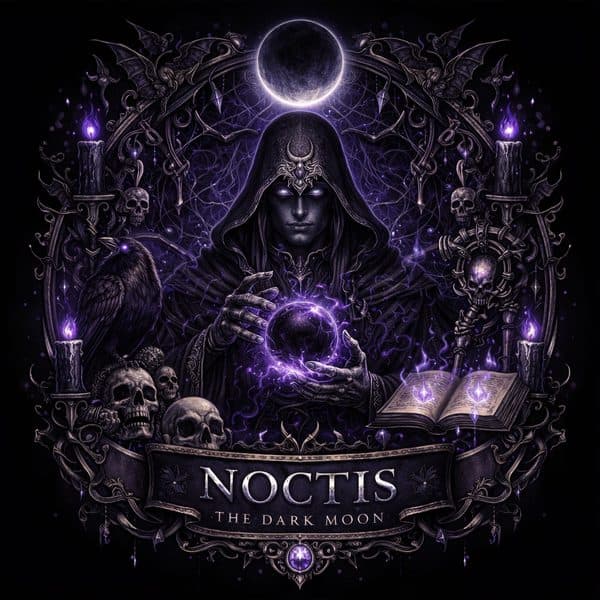
Noctis
Noctis — also known as Atraxis — is the god of the dark moon, shrouded in mystery and associated with the darker aspects of magic: necromancy, illusion, and transformation. Where Lunara heals, Noctis empowers. He is believed to amplify the forbidden arts, and his phases influence the behavior of nocturnal creatures and the potency of dark magic across Asphodel. His followers seek power through secret knowledge, and his presence can be felt in every shadow-drenched alley and forbidden library across the Shattered Coast.
Holy Symbol
A dark moon eclipsing its brighter twin, wreathed in arcane sigils
Domain
Shadow, Forbidden Magic, Necromancy, Illusion, Transformation, Secrets
Alignment
Neutral Evil
Status
Active
Factions
None
Worship & Rites
Conducted in darkness, often during eclipses or the dark of the moon when Noctis' influence is strongest. Rituals involve shadow-weaving, ink offerings, the exchange of whispered secrets, and blood-signed pacts of silence. Practitioners of necromancy and illusion magic time their most ambitious workings to Noctis' phases, believing his dark face amplifies what Lunara's light would suppress. Offerings of black candles, raven feathers, and vials of ink are left at hidden shrines.
Clergy & Organization
Secretive cabals of shadow-mages, necromancers, and knowledge brokers who guard their identities behind masks and aliases. There is no formal hierarchy — only loose networks of cells connected by coded messages and dead drops. The most powerful among them are called Umbral Seers, and they claim to hear Noctis' whispers directly during the darkest phase of his cycle. Initiation requires surrendering a true secret — one that could destroy the initiate if revealed.
Holy Days
The Eclipse
When the dark moon passes before the light, Noctis' faithful gather to perform their most powerful rituals and exchange their deepest secrets. It is said that during a full eclipse, the boundary between the living and the dead grows thin enough to whisper across.
The Night of Black Tides
Observed when Noctis' orbit pulls him closest to Asphodel, darkening the sky and stirring strange currents in the deep ocean. Nocturnal creatures grow bold, shadow magic surges in potency, and the faithful conduct their most dangerous experiments. Coastal towns bar their doors and hang silver charms blessed by Lunara's priests.
The Twin Ascension
The rare night when both moons are full simultaneously. Even Noctis' secretive faithful emerge to observe this event alongside Lunara's clergy — the one night when the eternal duality is perfectly balanced, and the most extraordinary feats of magic become possible.
Lore & History
Noctis is the dark twin — the second moon of Asphodel, a body shrouded in shadow that traces its own path across the night sky in an eternal counterpoint to Lunara's silver arc. Together they represent the fundamental duality of the universe: light and darkness, healing and transformation, order and chaos. One cannot exist without the other, and the magic system of Asphodel reflects this truth at its deepest level.
Where Lunara governs the visible tides and the growth of living things, Noctis holds dominion over what moves unseen. His phases influence the behavior of nocturnal creatures — wolves howl louder and hunt farther under his darkest face, deep-sea predators rise closer to the surface, and the undead grow restless in their graves. Shadow magic, necromancy, and illusion all wax and wane with his cycle, and practitioners of the forbidden arts chart his movements as carefully as any sailor charts Lunara's.
Noctis' worship is technically illegal in most civilized places, but his influence persists through underground networks of shadow-mages and seekers of forbidden truth. His followers argue that darkness is not evil — it is simply the other half of reality, the part that polite society refuses to acknowledge. Without Noctis, they say, there would be no mystery, no transformation, no growth through adversity. Lunara's light would blind rather than illuminate.
In the folklore of Asphodel, Noctis is viewed with a mixture of fear and reluctant respect. The people of the Shattered Coast call him the Whispering Eye and blame his dark phases for shipwrecks, madness, and the occasional surge of undead from old battlefields. The Frostvall clans see him as a necessary predator — dangerous but vital to the balance of the world. Among the Éirleach, he is a trickster figure, neither wholly malevolent nor trustworthy, whose shadows conceal as much wisdom as danger.
On clear nights, the interplay of Noctis' shadow and Lunara's silver light creates Asphodel's most distinctive feature: twin sets of shadows stretching from every object, overlapping and shifting as the moons trace their separate paths. When Noctis passes close to Lunara in the sky, the shadows merge and deepen, and even the bravest travelers quicken their pace. When the moons stand at opposite horizons, the world is caught between two kinds of light — and sorcerers say that in that moment, anything is possible.