Military & Defense Systems
The ancient powers that guard Ardenweald from destruction, wielded by those who have sworn to protect the forest and all who dwell within it.
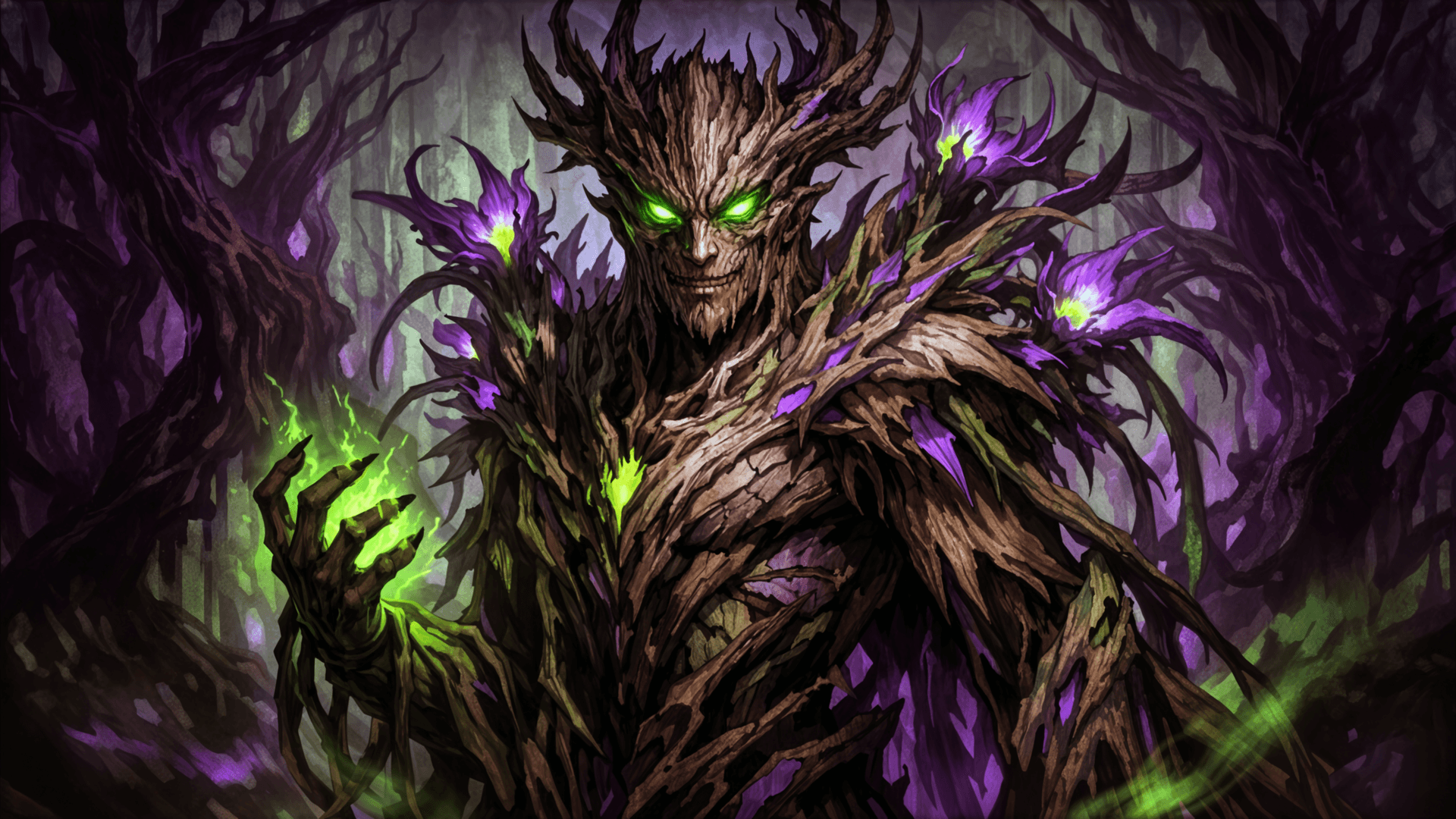
A Forest Sentinel — guardian of ancient boundaries
Forest Sentinels
The Forest Sentinels represent the apex of Ardenweald’s military prowess—elite ranger units whose mastery of camouflage, guerrilla warfare, and druidic magic has made them legendary throughout the lands. These warriors are not merely soldiers; they are extensions of the forest itself, moving through the canopy with the grace of deer and striking with the precision of hawks. Their training spans decades, demanding not only martial skill but spiritual attunement to the ancient rhythms of nature.
Combat Philosophy
The Sentinels eschew pitched battles in favor of asymmetric warfare. Their tactics revolve around ambush and misdirection—waiting with infinite patience for enemies to stumble into carefully constructed kill zones, then vanishing into the forest before superior numbers can respond. A single Sentinel squad of twelve can hold an entire regiment at bay within the deep woods, exploiting terrain and magical camouflage to remain effectively invisible.
Weapons & Combat Training
Sentinels are trained in a trinity of weapons. Their bows are crafted from wood still living within the tree, shaped through decades of magical cultivation to be impossibly responsive and accurate. Arrows fletched from enchanted feathers never miss their intended target over distances up to five hundred yards. Secondary weapons are spears with shafts of ironbark and heads tipped with points hardened through exposure to concentrated druidic essence—capable of piercing stone and steel with equal ease.
Beyond physical armament, Sentinels are instructed in the fundamentals of druidic magic. They cannot match true druids in raw power, but they know how to bend light and shadow, how to read the emotions of animals, and how to call upon the forest itself for aid. A Sentinel in their native woods benefits from advantages that make them appear almost superhuman to outsiders.
Training at Thornwatch
All Sentinels undergo their formative training at Thornwatch, a hidden military academy nestled in the deepest reaches of Ardenweald’s heart. Accessed only by those initiated in druidic ways, Thornwatch has existed for over a thousand years, its instructors passing down combat techniques refined through countless generations of warfare. Candidates endure trials of speed, strength, stealth, and magical affinity. Many do not survive the training; those who do emerge as living legends.
Sentinel Hierarchy
- Sentinel Commander: Supreme leader
- Green Wardens: Regional commanders
- Thornblades: Squad leaders (12-person units)
- Leafkin Rangers: Full members
- Sprouts: Apprentices in training
Notable Sentinel Leaders
- Lyrawen Shadowleaf: Sentinel Commander, master archer
- Torindel Rootwhisper: Green Warden of the Eastern Reaches
- Selayne Moonbow: Legendary scout, keeper of ancient tactics
- Kaelen Thornblade: Newest Green Warden, innovation-focused
Signature Tactics
- Silent Approach: Techniques for moving through dense forest without sound or scent detection
- Layered Ambush: Multiple strike teams positioned to envelope enemy forces from all directions
- Canopy Evasion: Methods for disappearing into upper forest levels, using branches as highways
- Phantom Strikes: Hit-and-run attacks that give appearance of multiple larger forces at work
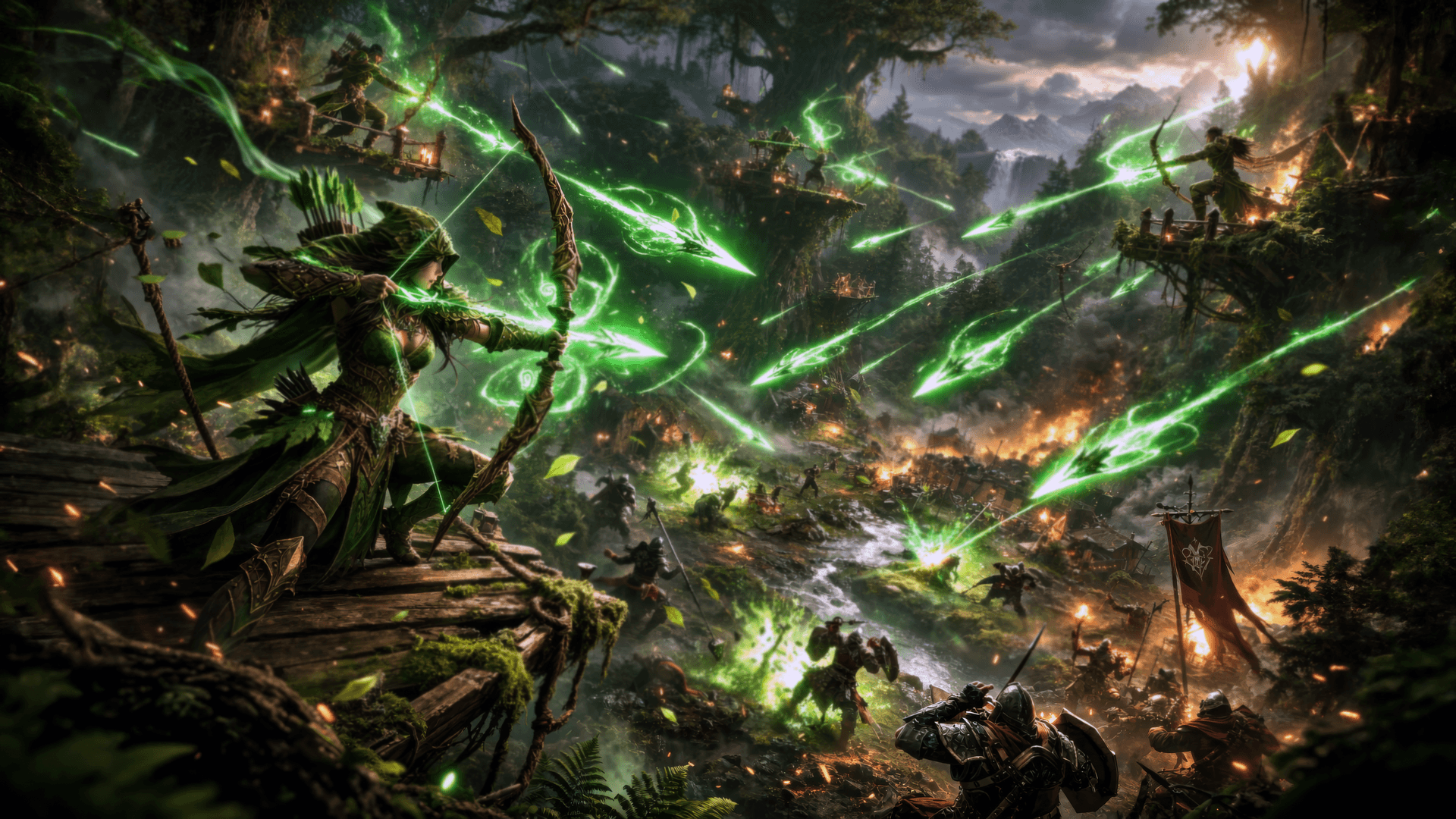
Glade warfare tactics
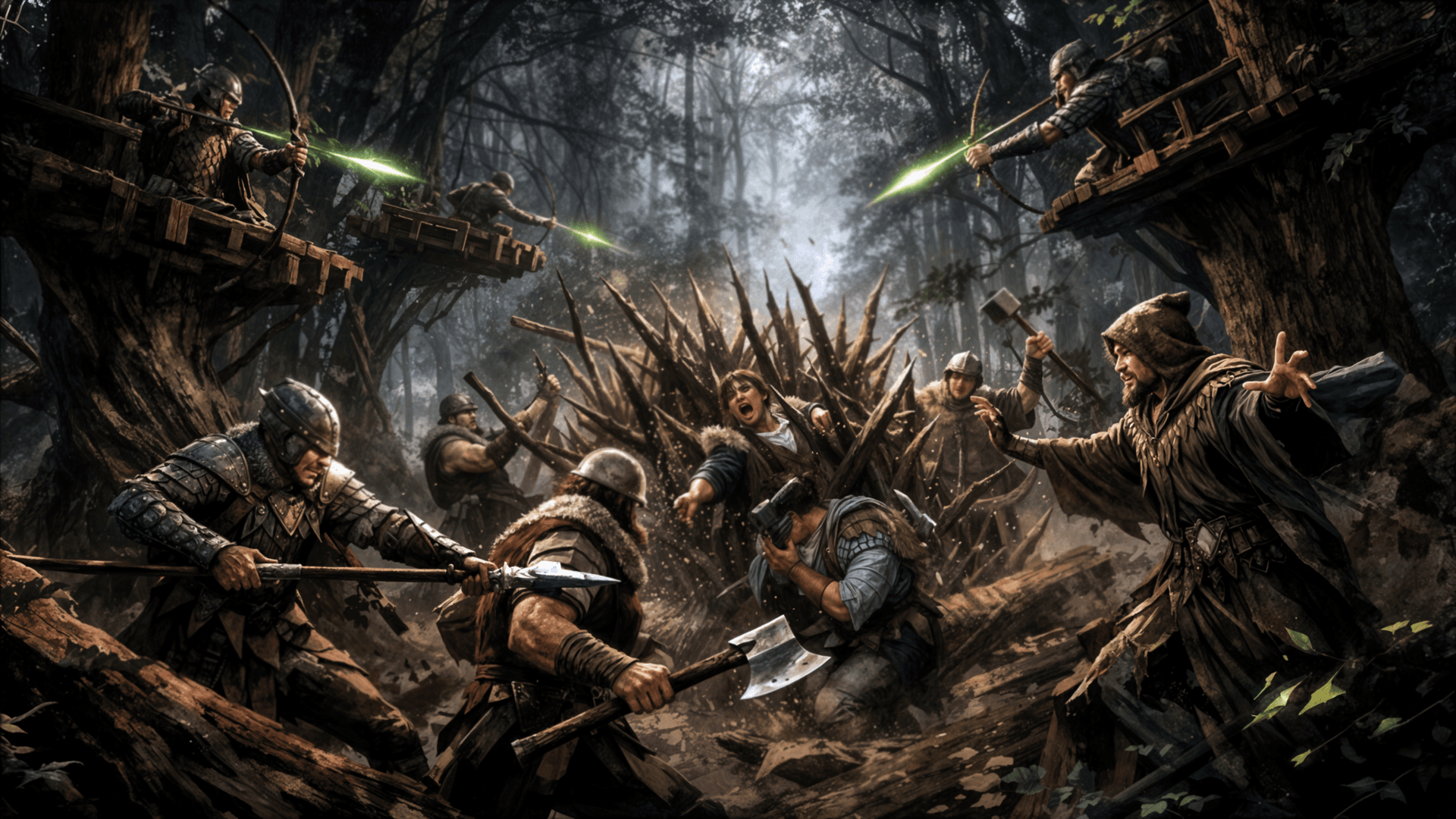
Forest ambush
Enchanted Defenses
Beyond the martial prowess of the Sentinels lies a deeper, more fundamental protection: a network of ancient enchantments woven into the very fabric of Ardenweald itself. These magical defenses are neither weapons nor fortifications in the traditional sense. Rather, they constitute a comprehensive system that makes the forest itself an impenetrable fortress, hostile to invaders yet welcoming to those in harmony with nature.
The Illusion Veil
The most immediate defense encounters any intruder face is the great Illusion Veil—a carefully maintained enchantment that causes Ardenweald to appear far less valuable than it truly is. To the untrained eye, the forest presents itself as impenetrable wilderness, thick with thorns, deadfall, and dangerous creatures. Paths that exist clearly to the wood-wise appear non-existent to outsiders. Lakes that sparkle with abundance seem murky and useless. Even the air itself feels hostile, alive with unseen threats.
This illusion requires constant maintenance, but it has proven devastatingly effective. Logging expeditions turn back after a single day of futile searching. Mining operations relocate after finding their tools mysteriously damaged and their workers afflicted with inexplicable despair. The forest does not need to reject invaders violently; it simply convinces them they have nothing to gain.
Wards of Confusion
Those determined or foolish enough to push deeper encounter the Ward Maze—layered enchantments designed to disorient and redirect. Intruders moving with hostile intent find themselves walking in circles, covering the same ground multiple times despite being convinced they progress steadily forward. Paths curve back on themselves. Landmarks seem to shift and move. Compasses spin uselessly. The forest becomes a labyrinth with no exit, designed to break the will of even the most determined invaders.
Terrain Traps & Living Obstacles
For those who penetrate the illusions and survive the wards, the forest itself becomes a weapon. Druidic cultivation over centuries has created an ecosystem specifically configured for defense:
- Root Ensnares: Ancient root systems awakened by druidic command that erupt from earth to entangle and immobilize
- Thorn Walls: Accelerated growth spells that cause thorned plants to surge upward, forming impenetrable barriers
- Quicksand Marshes: Strategically placed areas where magical compulsion causes earth to become unstable and treacherous
- Canopy Collapse: Weakened branches that fall only under the weight of those not of the forest
- Toxic Blooms: Cultivated flowers that release hallucinogenic spores to confuse intruders
The Ward Lines
Encircling all of Ardenweald are the Ward Lines—massive magical boundaries maintained in concentric rings from the outer reaches to the inner sanctum. The outer Ward Lines are subtle, nearly undetectable, alerting druids to the presence of intruders without barring passage completely. The middle rings become progressively more hostile, actively repelling those with destructive intent. The innermost Ward Lines represent the last bastion, requiring significantly powerful magic to penetrate and defended by Sentinels of legendary skill.
The Ward Lines adjust constantly, shifting their exact positions to confound mapping attempts. A path found one month may be completely blocked the next, redirecting with invisible force toward waiting defenders. Those aligned with nature’s purpose pass through without impediment; those opposed encounter growing resistance until they find themselves physically expelled from the forest.
Ward Maintenance Circles
The Ward Lines are maintained by circles of specialized druids working in coordinated shifts. Each circle oversees a specific region and ward layer, making minor adjustments daily and major renovations during the solstices and equinoxes.
The Twilight Council coordinates all ward maintenance, ensuring no gaps appear between shifts and monitoring for magical intrusions that might compromise the system. This work is exhausting and demands decades of training, but druids consider it among the highest honors to be selected for ward circles.
The Verdant Conclave
While the Forest Sentinels defend Ardenweald’s borders through martial might, the Verdant Conclave wages a subtler war beyond them. This secretive alliance operates a network of agents, saboteurs, and spies dedicated to opposing industrial expansion, logging operations, and mining efforts that threaten the natural world. Where traditional military forces are bound by geography, the Conclave operates everywhere civilization encroaches upon wilderness.
Structure & Philosophy
The Verdant Conclave is loosely organized into regional cells, each operating semi-independently while remaining coordinated through a network of trusted messengers and animal intermediaries. The Conclave’s members range from committed druids to sympathetic rangers, gnome engineers with alternative technologies, and even dissident humans and elves who reject industrial society. They are united not by culture or race, but by a shared conviction that industrial expansion represents an existential threat to all natural life.
Primary Methods
- Strategic Sabotage: Disabling equipment, fouling supplies, and creating mechanical failures in logging camps and mines
- Intelligence Networks: Operatives embedded in industry centers gathering information on expansion plans
- Supply Disruption: Intercepting shipments, poisoning provisions, and creating shortages that force operations to withdraw
- Environmental Manipulation: Accelerating river flooding, encouraging predators to forest edges, and other natural consequences
- Propaganda & Influence: Spreading warnings about forest dangers and environmental consequences through propaganda channels
Relationship with Broader Military
The relationship between the Verdant Conclave and official Ardenweald military forces is complicated. Officially, the Conclave does not exist—Ardenweald leadership neither acknowledges nor condemns their activities. Unofficially, there is subtle coordination. Forest Sentinels provide intelligence on operations outside Ardenweald’s borders. The Conclave, in turn, gathers information that helps the Sentinels anticipate major incursions.
However, tensions exist. Some Sentinels view Conclave methods as dishonorable, preferring open combat to sabotage and deception. Many in Ardenweald’s civilian leadership worry that Conclave activities will provoke military retaliation from powers like Fort Valiance. There are whispered debates about how far such operations should extend and whether targeting civilian workers is morally justified, even in service of a greater cause.
Agents & Operatives
The Conclave maintains a rotating network of dozens of operatives across human settlements, dwarven mining operations, and industrial centers. These agents operate under assumed identities, often for years before their true allegiance becomes apparent. Some are native to the regions they operate in, making their cover nearly impenetrable. Others are skilled in mimicry and deception, using magical glamours to appear as locals.
Notable operations have included the destruction of the Ironpeak Mining Consortium’s primary refinery, the poisoning of lumber reserves destined for Fort Valiance’s military expansion, and the systematic recruitment of disillusioned workers into Conclave cells. Each success strengthens the organization’s reputation; each exposed cell hardens resolve in their enemies.
Moral Complexities
The Verdant Conclave exists in a moral gray zone that troubles even its supporters. Sabotage operations kill workers, destroy livelihoods, and displace communities dependent on industry. Poisoning operations can spread beyond intended targets. The question haunts Conclave leadership: how many innocent lives justify protecting the forests? Where is the line between justified resistance and terrorism? These debates shape Conclave strategy and occasionally splinter cells over ethical disagreements.
Defensive Strategy
Ardenweald’s defense strategy is built on the principle of layered depth—the idea that an invading force must overcome progressively more intense obstacles before reaching anything vital. This layered approach means no single defensive weakness can compromise the entire system. An enemy breaching one line of defense finds themselves facing an even more formidable barrier.
Layers of Defense
Layer One: Outer Ward Line
The outermost magical boundary serves as an early warning system. Intruders are sensed immediately by the Twilight Council, activating protocols that mobilize Sentinel patrols and alert forest creatures to the presence of threats. This layer is deliberately non-lethal, designed to turn back conventional military forces without provoking direct conflict.
Layer Two: Illusion & Misdirection
The Veil and Ward Maze work to exhaust invaders mentally and physically before they ever engage Sentinels. Those attempting to map or navigate the forest find their efforts frustrated at every turn, supplies dwindle, morale collapses.
Layer Three: Sentinel Patrols
The primary fighting force consists of roaming Sentinel units trained to harass, ambush, and eliminate intruders. These forces know every inch of their territory and fight with supernatural advantages. A well-positioned Sentinel squad can halt a much larger conventional military force.
Layer Four: Terrain Traps
Those advancing despite Sentinel opposition encounter the forest itself rising against them—animated roots, collapsing earth, thorned barriers, and other magical hazards that thin their ranks without requiring active Sentinel engagement.
Layer Five: Inner Sanctum
At the heart of Ardenweald, the most powerful druids and legendary Sentinels maintain a final stronghold. Few forces have ever reached this point; none have breached it successfully. The entire forest funnels threatening forces toward this location, where defeat is absolute.
The Forest Fights Back
The fundamental principle underlying Ardenweald’s defense is that the forest itself is a conscious, active participant in its own protection. This is not mere metaphor. Through powerful druidic magic cultivated over millennia, the trees, stones, water, and creatures of Ardenweald possess a form of shared consciousness and can respond coordinated action. Paths shift to route enemies toward prepared kill zones. Trees bend to create barriers or drop branches on invaders. Streams flood on command. Even weather responds to druidic will—fog thickens to obscure, rain creates mud to slow advancement, wind carries sounds that confuse navigation attempts.
Communication Systems
Coordinating defense across vast forest territories requires sophisticated communication. Ardenweald employs multiple overlapping systems:
- Animal Messengers: Ravens and owls carry urgent reports between command centers, capable of traveling faster than any humanoid messenger
- Wind Whispers: Druidic magic allows voices to carry on winds, transmitting information across distances with delays of only minutes
- Root Network: The deepest magic, accessible only to elder druids, allows thoughts and information to flow through the interconnected root systems of ancient trees
- Crystal Echoes: Enchanted stones placed at strategic locations amplify sound and allow long-distance speech between trained operators
Emergency Protocols
Should invasion become imminent, Ardenweald activates tiered emergency responses. At the first warning level, all Sentinels mobilize and civilian populations move toward protected sanctuaries. At the second level, Ward Lines become fully hostile, actively repelling intruders rather than simply confusing them. At the final level—rarely reached in recent history—the druids invoke ancient protocols that transform entire regions into actively hostile terrain, prioritizing defense over preservation.
Weapons & Equipment
The weapons and equipment of Ardenweald’s forces reflect centuries of magical innovation and intimate partnership with the forest itself. Rather than being forged in smithies, they are grown through patient magical cultivation, resulting in tools that are lighter, stronger, and more responsive than any conventional manufacturing could produce.
Bows of Shaped Living Wood
Ardenweald’s master bowyers do not carve wood—they guide its growth. Beginning with a sapling selected for perfect grain and magical affinity, craftspeople spend years shaping it through a combination of pruning, magical conditioning, and environmental exposure. The resulting bows are impossibly responsive, nearly weightless despite their strength, and seem to anticipate the archer’s intentions. An arrow drawn from a Sentinel’s bow travels with uncanny accuracy, guided by subtle magic woven into the projectile itself. These bows are considered priceless artifacts; their loss in battle is mourned like the death of a comrade.
Spears of Ironbark & Thornpoint
Secondary weapons are spears crafted from ironbark—a magical wood harder than steel, grown in the deepest groves under conditions that take decades to establish. Shafts are selected for perfect balance and fitted with heads sharpened from crystallized thorn essence, material that has been exposed to concentrated druidic power until it becomes as hard as diamond. These spears pierce armor with contemptuous ease and leave wounds that resist normal healing, the thorn essence causing magical corruption that ordinary medicine cannot address.
Leaf-Mail Armor
Rather than heavy plate or mail, Sentinels wear armor woven from enchanted leaves and shaped vine, magically treated to become supple yet durable. This leaf-mail provides protection comparable to steel plate armor but maintains flexibility that allows superhuman acrobatic movement. More importantly, the armor actively blends with the forest, making wearers appear as part of the landscape unless they move quickly. In static positions, a Sentinel in leaf-mail becomes nearly invisible even to observers looking directly at them.
Armor Construction
Leaf-mail is individually tailored to each wearer, grown to match their specific measurements and movement patterns. The process requires three months of careful magical cultivation, with each piece being as much alive as the wearer. The armor must be regularly tended—exposed to moonlight, watered with special druidic infusions, and left to rest in sacred groves during the off-season.
Druidic Foci & Totems
Sentinel-druids carry enchanted foci—objects that serve as conduits for magical power. These might be staffs of shaped wood, totems carved from stone, or jewelry crafted from rare magical materials. Each focus is attuned to its bearer through years of magical bonding, becoming an extension of their will. A Sentinel wielding their focus can call upon the forest’s power more effectively, manifesting effects that would take significantly more effort for druids without such tools. The loss of a focus is traumatic, as the bonding runs deep; a severed focus leaves its bearer feeling diminished and incomplete.
Weapons Maintenance & Crafting
Ardenweald maintains a network of master craftspeople—the Armorers of Thornwatch, the Bowyers of Silvergrove, and the Stoneworkers of the Hidden Peaks. These craftspeople guard their knowledge jealously, passing techniques only to trusted apprentices. The creation of a single magical bow represents months of work; a full suit of leaf-mail demands three seasons minimum. This constraint means Ardenweald cannot rapidly expand its military forces through equipment production, but the quality of equipment they do produce is unmatched.
Relations with Other Powers
Ardenweald’s military doctrine is fundamentally defensive, but this does not mean the forest kingdom exists in isolation. Complex relationships with external powers shape strategic planning and inform military readiness. These relationships range from mutual hostility to awkward cooperation against shared threats.
Opposition to Fort Valiance
Fort Valiance represents Ardenweald’s most serious external military threat. This human kingdom’s aggressive expansion, coupled with their demand for resources and their complete indifference to environmental consequences, makes them a natural adversary. Fort Valiance military forces have probed Ardenweald’s borders repeatedly over the past century, each incursion repelled with sufficient force to discourage immediate follow-up.
The relationship is an uneasy balance. Fort Valiance possesses superior conventional military strength—larger armies, more fortifications, and greater industrial capacity. However, they have learned through bitter experience that invading Ardenweald is economically ruinous. The Verdant Conclave’s operations extend into Fort Valiance’s territories, disrupting supply lines and industrial operations. Military losses mount faster than acceptable. Resources invested in conquest yield negative returns. As a result, Fort Valiance maintains a posture of contained hostility rather than open warfare, blockading trade routes and funding neighboring kingdoms that might destabilize Ardenweald through indirect pressure.
Conflicts with Industry
Beyond Fort Valiance, Ardenweald faces pressure from independent logging operations, mining consortiums, and commercial ventures. These are often harder to combat than military forces because they operate through economic pressure and corrupt local governments. A logger displaced from one region simply moves to another. A mining operation shut down by Conclave action relocates and comes back stronger. Ardenweald’s druids have come to realize that military force alone cannot stop industrial expansion—they must also work to change hearts and minds, demonstrating the value of forests beyond timber and ore.
Notable Industrial Conflicts
- Ironpeak Mining: Attempted operations in northern foothills; driven out by coordinated Sentinel strikes
- Crown Timber Company: Logging operation attempting expansion; sabotaged by Conclave agents for three consecutive seasons
- Deepdelve Consortium: Underground mining in protected watershed; operations suspended after environmental catastrophe caused by Ardenweald druids
Cooperation Against Shared Threats
Not all of Ardenweald’s conflicts are with civilization. The Sporesworn—corrupted creatures from the far borderlands—represent a threat to all civilizations in the region. When Sporesworn incursions occurred fifteen years ago, Ardenweald’s druids worked briefly alongside Fort Valiance’s military forces, putting aside ancient hostilities to combat a greater threat. Ardenweald also maintains diplomatic channels with several smaller kingdoms, trading timber and magical goods for protection against larger threats.
Undead threats from curse-plagued lands have also prompted cooperation. Ardenweald’s druids possess unique power against undead creatures, and human kingdoms have learned to value this assistance. These temporary alliances suggest possibilities for eventual peace, though many in Ardenweald view such cooperation with suspicion—alliances born of desperation often dissolve as quickly as they form.
The Espionage Network
Beyond direct military action, Ardenweald maintains an extensive espionage network monitoring external civilizations. Trained agents embed themselves in major cities, observing military movements, economic conditions, and political developments. This intelligence allows Ardenweald to anticipate threats and adjust defenses before invasion becomes imminent. The network also enables the Verdant Conclave to coordinate operations more effectively, providing targets and intelligence to operatives far from home.
This intelligence work is often brutal. Agents who are discovered face execution. Double agents occasionally feed false information designed to provoke destructive conflicts between external powers. The moral cost of this work troubles many in Ardenweald, but the practical benefits are undeniable—early warning has saved the forest from catastrophic invasions on multiple occasions.
Strategic Considerations
Ardenweald’s military strategy assumes that its greatest defense lies in making invasion economically unviable and politically unpalatable. As resources become scarcer and climate conditions change, this calculation may shift. Military planners within Thornwatch have begun serious discussions about what happens if external powers become desperate enough to launch full-scale invasion despite the costs. These discussions have led to increased focus on training and magical capability development—preparing for a war that they hope will never come, but which increasingly seems possible.